Carter v. Carter, — So. 3d —-, 2026 WL 1154012
Fla. 4th DCA, April 29, 2026
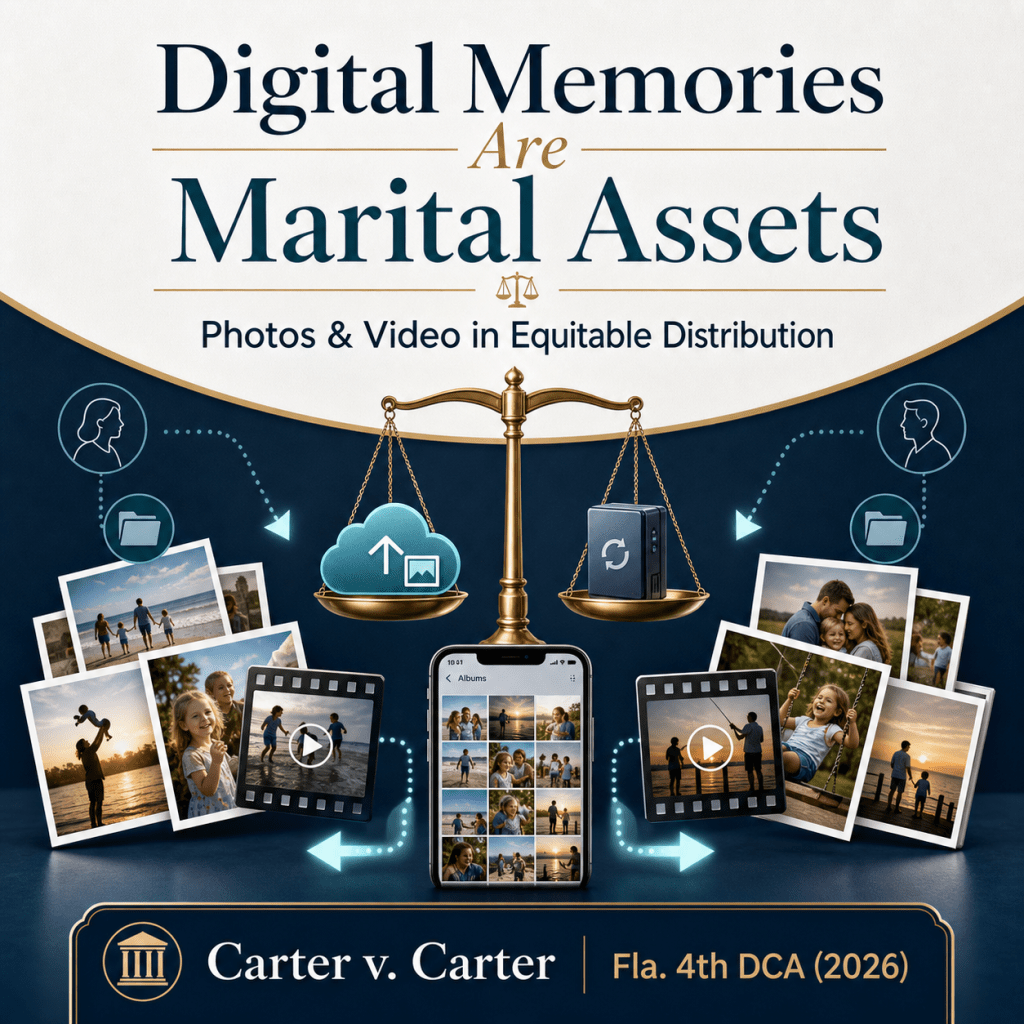
In Carter v. Carter, the Fourth District recognized something every modern family lawyer should already understand: family photographs and videos are not merely sentimental afterthoughts. When created, collected, or preserved during the marriage, they may be marital assets subject to equitable distribution.
The case involved, among other things, family photographs and videos stored on the Husband’s hard drives. The issue became contested before and during trial, particularly because Wife sought access to family memories, including photographs connected to her recently deceased mother. Although the trial court entered a limited order requiring Husband to provide some photographs, the final judgment failed to identify and distribute the broader collection of family photographs and videos as part of equitable distribution. The Fourth District reversed.
The appellate court’s reasoning is important. Marital assets are not limited to assets with a clean market value, such as real estate, retirement accounts, vehicles, or business interests. Section 61.075 includes assets acquired during the marriage, and the Fourth District looked to the beneficial nature of these family keepsakes. The court held that the family photographs and videos were “beneficially acquired by both parties during the marriage” and were the “fruit of the couple’s activities” because they depicted the parties’ married life and memories with their child.
That holding matters.
In today’s world, a family’s history often exists on phones, hard drives, cloud accounts, shared albums, external drives, and digital backups. Birthdays, vacations, school events, holidays, first steps, graduations, family gatherings, and ordinary moments with children may all live in digital form. If one spouse controls the device, cloud account, or hard drive, the other spouse can effectively be cut off from years of family history.
Carter reminds practitioners that equitable distribution is not just about dividing things that can be sold. It is also about fairly allocating property and access to property acquired during the marriage. A folder of photographs may not have a Kelley Blue Book value, but its emotional and familial value can be enormous.
The practical lesson is simple: do not leave digital media out of the equitable distribution analysis. If family photographs, videos, or digital archives exist, they should be identified, preserved, and distributed. The remedy may be as practical as requiring duplication, cloud sharing, forensic copying, or a protocol that protects privacy while ensuring both parties receive access to marital family media.
The opinion also reflects an important procedural point. Even if the issue was not perfectly pled, the Fourth District found the issue was tried by implied consent because the parties contested the photographs and videos before and during trial. That said, the better practice is to plead it clearly, list it in the equitable distribution schedule, and request a specific distribution mechanism.
This does not mean a spouse receives unlimited access to the other party’s private device or entire digital life. Courts can and should tailor relief to family photographs, videos, and marital media while protecting privileged, confidential, irrelevant, or private material.
But the core point is now clear from the Fourth District: family digital media acquired during the marriage can be a marital asset, and the final judgment should account for it.
 Stephens & Stevens Marital & Family Law
Leave a comment