Originally published in the Family Law Section Commentator Vol. XLVIII, Issue 4|2026
By Eddie Stephens and Noelle E. Stone
Photos by Coastal Click Photography
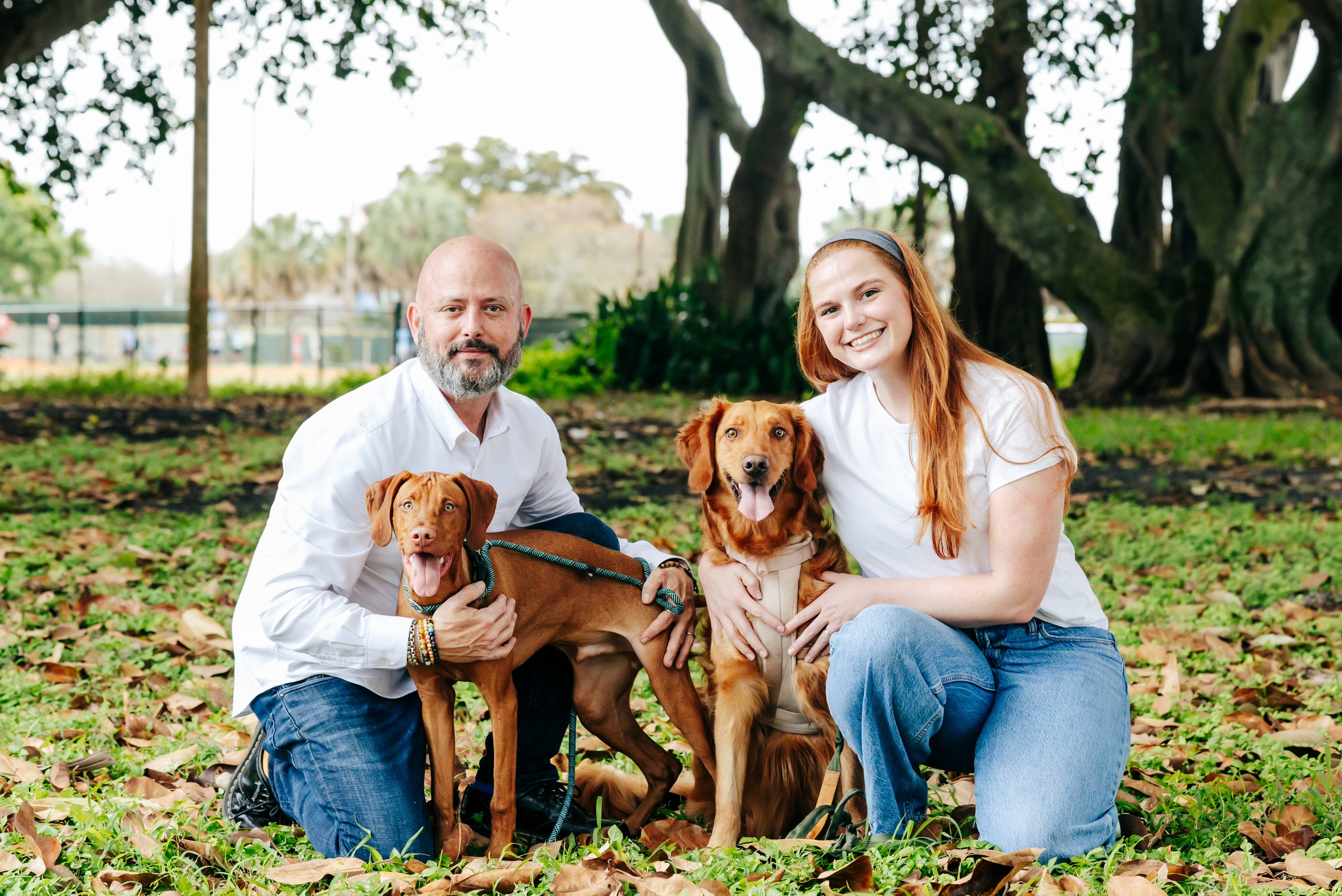
Tucker was not a couch, a lamp, or a line item on a balance sheet. He was a golden doodle, bought during a marriage, loved by both spouses, cared for in daily life, taken to doggy day care, trained, and woven into the emotional fabric of a home. When that marriage ended, both parties wanted him so they agreed to remain equal owners of Tucker. The trial court entered its final judgment, which contained this stipulated agreement—effectively preserving a form of shared custody. But Florida’s Fourth District rejected that approach. In Crossen v. Feeley, the court held that Tucker had to be equitably distributed to one party or the other, because under Florida law, a dog remains personal property, akin to a couch, even if the parties’ reality looks more like a custody dispute than a property fight.[i]

Tucker’s story captures a core tension in modern family law. Roughly seventy-one (71%) of American households own a pet, meaning seventy-one percent of Americans understand that companion animals are sentient, bonded beings whose welfare matters.[ii] Yet in many jurisdictions, the law still treats them as property. That legal fiction has become increasingly difficult to defend as courts and legislatures around the world experiment with frameworks that acknowledge the unique status of pets without collapsing the distinction between animals and children. This article surveys those evolving approaches, contrasts them with Florida’s still-limited doctrinal framework, and argues that Florida should adopt a carefully cabined statutory reform that reflects both reality and restraint.

I. The Traditional American Approach: Pets as Personal Property
Historically, U.S. courts have treated pets as chattel, an approach rooted in centuries-old common law. Under this framework, pets are distributed through equitable distribution principles. Rather than any custody-style analysis. Courts do not traditionally award joint ownership or timesharing for pets. They further do not retain ongoing jurisdiction over pet disputes, and do not treat the emotional bond between a person and an animal as equivalent to the parent-child or sibling bond. Remedies are generally economic, and the conceptual model is one of ownership, not relational care.
This approach reflects institutional concerns: preserving limited court resources, avoiding endless post-judgment litigation, and reluctance to analogize pets to humans. Yet these justifications increasingly fail to reflect the lived experience of those for whom a companion animal is plainly more than a household asset; they’re a central part of the family.

II. The Spectrum of Modern Reform in U.S. Jurisdictions
A. “Personal Property Plus”: A Measured Evolution
Several U.S. states have adopted modest reforms that soften—but do not abandon—the property model.
The first is a “personal property plus” approach. This model keeps pets within the property framework but allows courts to consider limited humane factors in deciding which party should receive the animal. Pennsylvania’s proposed legislation is a good example. It preserves the property classification while authorizing courts to consider matters such as premarital ownership, caregiving history, the ability to promote the animal’s well-being, and a child’s attachment to the pet. Alaska and New York have likewise moved toward allowing a court to consider the animal’s well-being without transforming the inquiry into full custody litigation.
The second is a more flexible “quasi-custodial model”. Some courts, through case law rather than statute, have considered stability, historical care, and practical welfare concerns when awarding possession. In a handful of jurisdictions, courts have even approved shared arrangements or visitation-type outcomes. These cases reflect an instinctive judicial recognition that pets occupy a space between property and personhood. But without statutory guardrails, that flexibility risks inconsistency, unpredictability, and exactly the sort of litigation sprawl that makes judges wary.

III. International Perspectives: When Pets Are No Longer “Property”
International developments underscore how quickly the legal ground is shifting.
A landmark Turkish divorce case attracted international attention when a court ordered an ex-husband to pay ongoing financial support for his former spouse’s cat—approximately 84,000 Turkish Lira (roughly 1890 USD) annually for a decade.[iii]
Turkey’s animal protection laws classify pets as living beings, not property, and allow courts to approve agreements related to custody, care, and financial support of pets in a divorce. While the payments were technically part of a contractual settlement rather than “pet alimony,” the outcome underscores a crucial point: when animals are legally recognized as sentient, courts can impose long-term care obligations; unthinkable under the current Florida doctrine.
Australia takes animal welfare even more seriously, having a prominent political party dedicated to promoting animal welfare and justice.[iv] The Family Law Amendment Act of 2024 represents the country’s most comprehensive reform to date.[v] Effective June 2024, pets are recognized as sentient beings and are treated with the same legal status as other family members, so courts must consider practical caregiving, veterinary support, emotional and physical needs, domestic violence, and family context. Importantly, the Australian model is not simply about splitting time equally. It is welfare-focused, and in some cases, that means rejecting shared arrangements if they would be stressful or unsuitable for the animal.

British Columbia’s statutory reform, The Family Law Act, similarly classifies pets as family members rather than property, while simultaneously forbidding court-ordered shared custody absent party agreement.[vi] These courts consider care history and family violence but aim to avoid prolonged entanglement. Protecting both pets and judicial resources.
In Glassen v. Glassen, the first major application of the law, the Supreme Court of British Columbia awarded sole possession of a dog, Toba, based on stability and routine, despite prior informal sharing—demonstrating thoughtful balance between compassion and finality.[vii]

IV. Florida After Crossen: Still Property, But No Longer Entirely Static
Florida remains one of the most restrictive jurisdictions in the United States regarding pets in divorce.
First, a Florida court may not evade the issue by leaving former spouses as perpetual joint owners of a pet after divorce. The Fourth District held that the trial court erred by doing exactly that with Tucker. One party or the other had to receive the dog through equitable distribution, despite their agreement otherwise. In other words, Florida law still rejects “pet custody,” but it also rejects a pseudo-custody arrangement masquerading as continued co-ownership even when agreed by the parties.
Second, Crossen confirms that pet disputes belong inside the ordinary equitable-distribution framework of section 61.075.[viii] The court cited Harby v. Harby, for the proposition that a trial court may consider a party’s sentimental interest in property, including the ordinary attachment to pets, alongside the statutory equitable distribution factors.[ix] This is a significant nuance. Florida still treats pets as property, but emotional attachment is not entirely invisible at the distribution stage. It is simply not elevated to a welfare analysis, yet.

V. Why Crossen Strengthens the Case for Reform
Paradoxically, Crossen strengthens the argument for statutory reform precisely by showing the limitations of relying on ad hoc property doctrine.
Tucker’s story illustrates the practical problem. The evidence in the case looked strikingly like custody evidence: who selected the dog, who was home with him, how he was cared for, and why each party believed they should keep him. The Fourth District itself acknowledged that much of the testimony in dog disputes resembles child custody litigation. But because Florida has no statutory pet framework, courts are left to squeeze these human realities into an equitable distribution scheme that was never designed for sentient companions.

That mismatch produces avoidable instability. Some judges may focus narrowly on ownership and purchase price. Others may quietly weigh caregiving history or emotional bonds through the catchall equitable factors. Still others may, as the trial court did in Crossen, drift toward an unworkable shared-ownership solution that the appellate court later must reverse. The result is uncertainty for litigants, inconsistency for judges, trauma for children affected by the divorce, and stress for animals used as leverage in high-conflict breakups.

VI. The Unspoken Trauma of Children Separated From Pets in Divorce
For a child navigating the reality of their parents’ divorce, a pet is often a primary source of comfort and consistency. The disruption of dividing time between two households is already significant; the additional loss of a constant companion can compound that instability in a way the law does not fully account for.
The cornerstone of any parenting plan is the best interest of the child. Under Fla. Stat. 61.13, courts are required to evaluate a child’s life holistically, including the need for stability, continuity, and consistent emotional support. Yet the current framework creates a disconnect; a child’s bond with a pet cannot be incorporated into the parenting plan itself. The pet must be awarded as property to one parent and cannot follow the child between homes, even when doing so would support continuity and be in the child’s best interest.

As a result, this rigid framework leaves no room for enforceable, child-centered outcomes that would allow a pet to remain a consistent presence as the child adjusts to life across two households.
VII. A Modest Florida Reform Model
Florida does not need to equate pets with children. It should not create a full-blown best-interests custody code for animals. But it can modernize the law in a measured, restrained way—and Crossen v. Feeley shows precisely why it must.
A targeted statutory reform could accomplish this through five straightforward principles.

First, it would authorize a limited, factor-based determination of possession for companion animals in dissolution proceedings. Those factors might include historical caregiving roles, daily caretaking responsibility, the stability of each party’s home environment, documented family violence or animal abuse, bonds with a child, and each party’s practical ability to meet the animal’s physical and emotional needs. These are not exotic considerations. They are the same common-sense questions any thoughtful person would ask. Florida courts simply lack the authority to ask them.
Second, the statute would make clear that courts are deciding final possession—not shared custody. This preserves Bennett‘s legitimate concern with finality and judicial economy while foreclosing the kind of improvised co-ownership arrangement the Fourth District was compelled to reject in Crossen. The trial court in that case was not wrong to want a humane outcome. It was simply working without a legal foundation to support it.
Third, courts would be expressly permitted to consider documented financial contributions to the animal’s care during the pendency of the case—veterinary costs, training, boarding, and other necessary expenses. Crossen reversed the trial court’s failure to honor the parties’ stipulation that the husband would responsible for Tucker’s post-petition medical bills. A statute codifying that obligation would prevent the same error from recurring across trial courts statewide.
Fourth, modification jurisdiction would be prohibited except by agreement or extraordinary circumstance. Pet disputes should end. Parties should be able to move forward. Keeping litigation open indefinitely serves no one—least of all the animal.
Fifth, and perhaps most importantly, the statute would give the courts something Bennett never did: a clear statement of principle. A companion animal is neither a child nor a couch. Florida law can say exactly that, without apology. The goal is humane clarity—a framework that reflects what Floridians already know to be true, expressed in terms courts can reliably apply.

None of this requires the Legislature to reimagine family law. It requires only the recognition that a thirty-year-old precedent built for a different era is no longer sufficient—and that Tucker, and every animal like him, deserves at least that much.
Tucker’s story makes the issue impossible to dismiss as theoretical. A dog loved by both spouses became the subject of a legal framework that could neither comfortably treat him as mere property nor lawfully treat him as a child. The Fourth District’s answer in Crossen was faithful to current Florida law: no joint custody, no perpetual co-ownership, and no escape from equitable distribution. But the case also exposed the inadequacy of a purely property-based system for resolving disputes over sentient companions.
Elsewhere, legislatures and courts are beginning to acknowledge that pets occupy a distinct legal and emotional category. Florida need not leap to the far edge of reform. But it should recognize what Tucker’s case already shows: the old fiction is under strain, trial courts need guidance, and modest statutory reform can honor both compassion and constraint. The question is no longer whether pet disputes in divorce deserve serious legal treatment. The question is whether Florida will continue improvising through property doctrine, or finally adopt rules that reflect the world as families actually live in it.

[i] Crossen v. Feeley, 51 Fla. L. Weekly D273 (Fla. 4th DCA 2026).
[ii] Industry Trends & Stats, American Pet Products Association, https://americanpetproducts.org/industry-trends-and-stats
[iii] Turkish man agrees to provide financial support for cats in divorce settlement, Türkiye Today (Oct. 21, 2025)
[iv] Animal Justice Party, Animal Justice Party, https://www.animaljusticeparty.org.
[v] Family Law Amendment Act 2024 (Cth) (Austl.).
[vi] Family Law Act, S.B.C. 2024 (Can.).
[vii] Glassen v. Glassen, 2025 BCSC 640 (Can. B.C. Sup. Ct.).
[viii] § 61.075(1)(a), Fla. Stat. (2025)
[ix] Harby v. Harby, 331 So. 3d 814 (Fla. 2d DCA 2021).

 Stephens & Stevens Marital & Family Law
Leave a comment