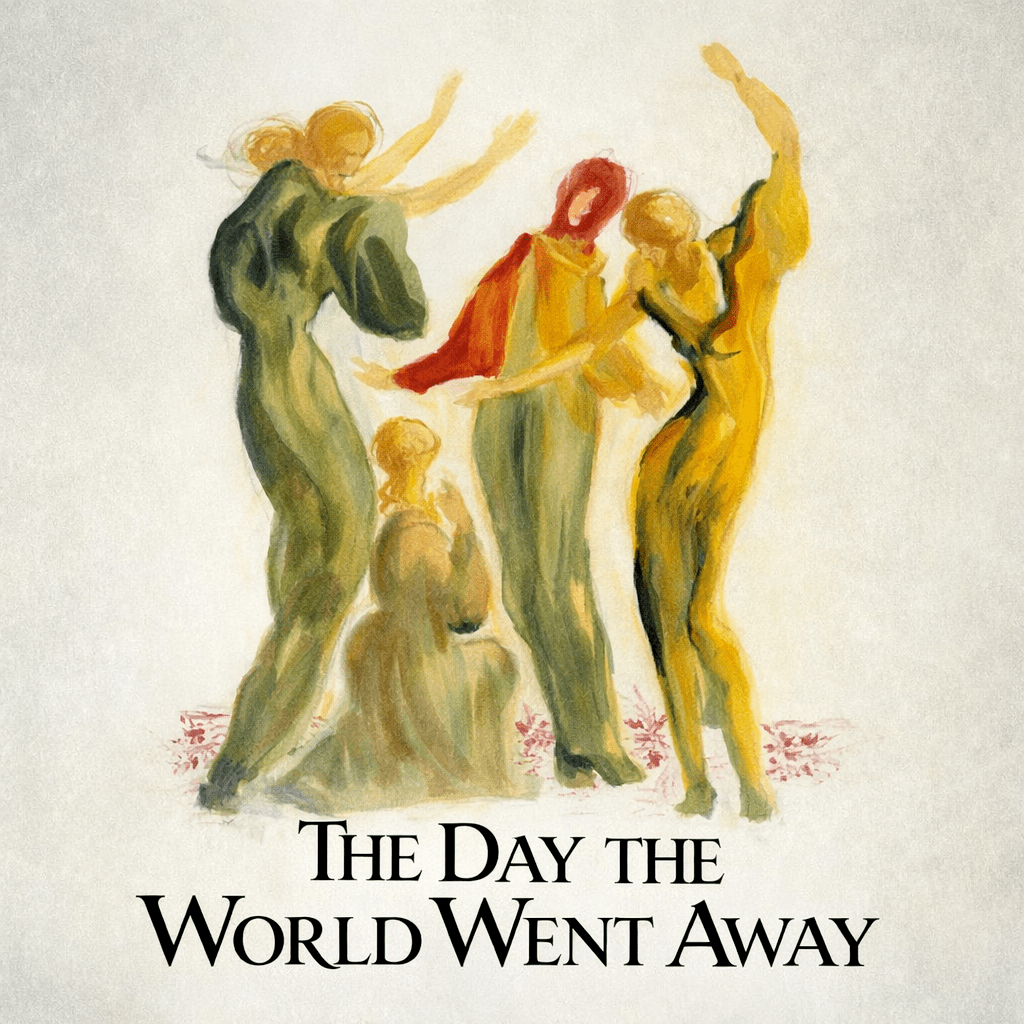
This essay contains descriptions of a parent’s suicide, childhood trauma, grief, and mental health recovery. Readers who have experienced loss, suicide, or family trauma may find portions of this story emotionally difficult.
I remember the hallway before I remember the room.
Her bedroom door was mostly closed.
I knocked anyway, twice. No answer. I pushed the door open and the first thing that hit me wasn’t a sight. It was the stillness.
She was on the bed. Not sleeping. Not resting.
Unresponsive.
I said “Mom?” like the word could pull her back. I said it again, louder, and the sound came out thin and useless. I moved closer and saw the bottle on the nightstand. Tylenol.
My brain tried to make it ordinary. Tried to put it in a box labeled misunderstanding or exaggeration.
I didn’t know what to do.
So I called the oldest authority I knew.
My grandmother answered like she always did — steady, controlled, polished.
“Where are you?”
“In Mom’s room. She’s… she won’t wake up. There’s an empty bottle. I don’t know…”
A pause. Not the pause of panic. The pause of calculation.
And then: “Don’t call anyone.”
I blinked. “What?”
“Do not call for help,” she said again. “You don’t know what this is. You don’t want the neighbors involved. You don’t want an ambulance outside. People talk.”
People talk.
As if the greatest danger in that room was gossip.
She treated it like regular “drug behavior” — something shameful and familiar. Something you handle privately, quietly, behind a closed door. Maybe in her mind that was love: damage control. Keeping the family name intact.
But in my mind, there was only one story that mattered.
I looked at my mother, at the shape of her, at the fact of her, and something in me snapped.
A rebellion so pure it felt like a switch flipping.
I said, “No.”
Not to my grandmother. To the universe.
My fingers dialed 911.
When the paramedics arrived, the house filled with motion that cut through the polite Coral Gables silence. I remember the stretcher, the commands, the equipment. I remember how professionals move when they’ve seen this before.
They worked and worked and worked, and I stood in the doorway feeling both too present and not present at all. Like my body was there but my mind had stepped outside itself to survive what it was watching.
And still, it was too late in the way that counts.
My mom didn’t die that day. Not exactly.
She stayed in that in-between place for six days. Six long, brutal, suspended days.
And then she died.
Afterward, everyone has a version of the story they can tolerate.
Some people made it a tragedy with a clean moral. Some made it a cautionary tale. Some made it a family secret, folded neatly and put away like a stained tablecloth.
The version that lived inside me was the one nobody else could carry. The moment where a single phone call decided what kind of person I would become.
Because here’s what haunted me and saved me in equal measure:
If I had followed orders, I would have survived the day. But I don’t know if I would have survived myself.
Calling for help didn’t change the outcome. That ending came anyway.
But it changed me.
It meant that when I look back — at the day the world went away — I don’t have to carry the extra weight of what if I hadn’t tried.
I tried.
I chose love.
And who knew that the first real adult decision of my life would be this: rebel against the family rulebook. Choose compassion over reputation.
That day didn’t just break my heart.
It forged something.
Before my mother died, I wasn’t a student in the way people usually mean it.
I showed up. I attended class. I completed enough work to move forward. But school often felt like a place I occupied rather than a place where I belonged.
The strange part is that I wasn’t struggling because I couldn’t learn.
In fact, some of my earliest memories involve becoming completely absorbed in things that fascinated me.
One summer, a nail through my foot changed the trajectory of my plans.
I was supposed to attend Ron Frazier’s University of Miami baseball camp. Instead, I ended up at a computer camp.
This was 1981.
Personal computers were still curiosities. Most people had never touched one.
I walked into a room filled with Apple II Plus computers and sat down in front of a black screen with a blinking green cursor.
Something about it felt familiar before I understood why.
The cursor waited.
I typed.
The machine responded.
I typed again.
The machine responded again.
Within hours, I was lost in it. Not lost the way people use the word casually. Lost the way a diver disappears beneath the surface. Entire afternoons vanished. The outside world faded. Time stopped mattering.
The computer operated according to rules that were clear, consistent, and logical. If something happened, there was a reason. If something was broken, there was a solution. If you asked the right question, eventually you found the answer.
The world made sense there.
For most people, a mentor arrives in the form of a teacher, coach, or family member.
For me, it was a machine.
The Apple didn’t care whether I fit in. It didn’t care whether I was athletic, popular, or understood. It rewarded curiosity and attention. The deeper I went, the more it revealed.
I became fascinated by systems. How things worked. How they connected. How information moved from one place to another.
Eventually that curiosity led me somewhere it shouldn’t have.
Back at school, I discovered the hidden architecture behind the adult world. Records. Files. Information.
And one day I crossed a line.
Not because I was trying to hurt anyone. Not because I was trying to cheat. I was trying to solve a problem. My sister had received a grade I believed was unfair, and I found a way to change it.
At the time, it felt less like misconduct and more like correcting an error.
Adults tend to focus on the action. Children focus on the intention.
The adults saw a serious breach. I saw a system that could be fixed.
Both perspectives were true.
What followed were meetings, evaluations, labels, and decisions made by people trying to determine what kind of child I was.
My sister was sent to the gifted program.
I was sent somewhere else.
The message I absorbed wasn’t necessarily the message anyone intended to send, but children are often experts at drawing conclusions from incomplete information.
My sister was gifted.
I was difficult.
My sister fit the system.
I confused it.
Looking back now, I suspect what adults were seeing wasn’t defiance so much as difference. I experienced the world intensely. My attention was either fully engaged or somewhere else entirely. Subjects that interested me became obsessions. Subjects that didn’t often disappeared from view.
I could spend hours focused on a single idea and forget everything around me.
I often felt out of sync with the people around me. And eventually, if enough people treat you like an outsider, you begin to wear the role yourself.
By fifteen, I wasn’t failing.
I wasn’t thriving either.
I was drifting.
Then came the bedroom in Coral Gables.
Then came the phone in my hand.
Then came the moment when the ordinary world ended.
After my mother died, school changed shape.
It stopped being a place I attended and became a life raft.
Grief is not just sadness. It’s drowning. It’s being pulled under by something invisible while everyone around you is still breathing like normal. And when you’re drowning, you reach for anything that holds you above the surface.
For me, that thing was achievement.
Not because I suddenly loved worksheets.
Because perfection is control. Because an A is a clean outcome in a world that had become unclean.
From that day forward I didn’t get less than perfect scores. Straight A’s. Through high school, through college, through law school. A switch that flipped and never turned off again.
But the truth is more complicated than a turnaround.
It wasn’t just motivation. It was survival. It was the way a mind builds a system after the old system collapses. It was a boy who couldn’t save his mother deciding that he would never again be powerless in a moment that mattered.
So yes — one event can do that. One series of moments can turn a drifting kid into something else entirely. But it isn’t the event itself. It’s the bargain you make in the wreckage.
The vow that gets spoken in the dark:
I will not be the kid who fails again.
I will not be the one who didn’t do enough.
If I can’t control life, I will control my performance.
That vow can build a career. A reputation. A transcript that looks like proof of something healed.
But it can also become a haunting.
Because perfection is a powerful drug. And grief doesn’t disappear because you’ve learned to win.
It waits. It watches. It takes notes.
What I didn’t understand then — what I couldn’t have understood — was how much of that excellence was running on emergency fuel. The grief didn’t leave. It went quiet.
And quiet things have a way of waiting until you can finally hear them.
The Day the Emergency Ended
For most of my life, I thought I was normal.
Not normal in the sense that everything was easy. I knew I was driven. I knew I was intense. I knew my brain never stopped moving. But I assumed everyone lived with the same internal soundtrack — constantly assessing risks, anticipating problems, preparing for disasters, calculating contingency plans.
That was just adulthood.
That was responsibility.
That was success.
At least, that’s what I told myself.
The truth is that somewhere around the age of fifteen, my nervous system made a decision.
The world was not safe.
It wasn’t a conscious choice. It wasn’t something I voted on. It was a survival adaptation forged in a moment when life stopped making sense. One day I was a teenager worried about grades, friends, comic books, and what the future might hold. The next, I was standing in a hospital watching my mother die.
My brain learned a lesson that day.
Anything can happen.
Anyone can disappear.
You must be ready.
And so I was.
For decades.
I built a life that many people would admire. I became a lawyer. Built a successful practice. Tried cases. Led organizations. Taught seminars. Raised children. Supported clients through some of the worst moments of their lives.
From the outside, I appeared confident.
From the inside, I was always on watch.
My mind was a security guard working a double shift that never ended.
Every room was scanned. Every conversation analyzed. Every future catastrophe anticipated before it arrived.
I wasn’t relaxing. I was preparing.
I wasn’t resting. I was monitoring.
I wasn’t present. I was surviving.
The strange thing about living in a constant state of vigilance is that eventually you stop noticing it. A fish does not notice water. It simply swims.
I had no idea that most people did not live this way.
I thought the constant noise in my head was normal. I thought always being ready was a virtue. I thought the ability to anticipate every possible problem was a gift.
And in many ways, it was. It helped me build a career. It helped me protect clients. It helped me navigate adversity.
But it came with a cost.
Feelings became muted. Rest became difficult. Being present became almost impossible.
I was always somewhere else — replaying the past or preparing for the future.
Rarely just here.
Then, fourteen months ago, I started EMDR therapy.
If I’m being honest, I didn’t know what I was getting into.
There were paddles. There were memories. There were questions. I was being guided into places I had spent a lifetime avoiding.
At first, the changes were subtle.
I remember getting goosebumps. That sounds insignificant, but it wasn’t. Something inside me was waking up.
Then came emotions. Not dramatic emotions. Normal emotions — the kind most people experience without thinking. I realized I had spent years observing feelings more than actually feeling them.
Before EMDR, I could count on one hand the number of times I had cried as an adult. Now tears arrive when they belong. At funerals. During meaningful conversations. Listening to a song. Reading something beautiful. Watching someone I love succeed.
The emotions are no longer trapped behind glass. They’re part of the experience.
The biggest surprise, however, was silence.
Not actual silence. Internal silence.
For as long as I can remember, my brain was a hamster on a wheel — constant movement, constant analysis, constant preparation. One day I noticed something unusual. The wheel had stopped. Not permanently. Not completely. But I discovered that I could actually quiet my mind. I could sit with a moment instead of dissecting it. I could experience something without simultaneously preparing for what came next.
For someone who spent forty years living in survival mode, this felt almost supernatural.
Another unexpected casualty of healing was my combative nature. I had always viewed it as part of my personality — direct, argumentative, ready, prepared for battle. A useful trait for a trial lawyer.
But as the work progressed, I began to realize that much of that energy wasn’t confidence. It was defense. A shield that had become so familiar I mistook it for my identity.
As that shield softened, something else emerged.
Curiosity. Patience. Presence.
The need to fight every battle slowly disappeared. Not because I became weak. Because I no longer felt under attack.
Then came a session I will never forget.
I found myself standing face to face with my fifteen-year-old self.
Not as a memory. Not as a photograph. As a person.
The boy whose world had ended. The boy who had lost his mother. The boy who had been forced to grow up far too quickly.
I was carrying a glowing orb of light. I don’t know where it came from or what it represented — healing, safety, compassion, understanding. Maybe all of those things.
I handed it to him.
He took it without hesitation. Without suspicion. Without fear. He slipped it into his pocket as though it belonged there.
Then he looked at me and smiled.
“What took you so long?”
Not with anger. Not with resentment. With relief. As though he had known I would eventually find my way back. As though he had been waiting for me all along.
Then he reached into his pocket and handed me a key.
A simple key.
And in that moment, everything changed.
The light was something I thought he needed. The key was something I didn’t know I was missing.
For years I had believed that fifteen-year-old boy was frozen in the hospital room. Broken there. Trapped there. Waiting to be rescued.
But the image told a different story entirely.
He wasn’t broken. He survived.
While I was busy building a career, building a family, building armor, he had been quietly safeguarding the parts of me I couldn’t afford to access while surviving.
Wonder. Sadness. Joy. Hope. Trust. The ability to feel deeply. The ability to simply be.
I thought I had come there to save him.
Instead, he was helping me.
The lawyer built a career. The adult built a life. The survivor built armor.
But the boy held the key.
Patiently. Faithfully. Waiting until I was finally ready to receive it.
That may be the greatest gift this work has given me — the realization that the emergency is over.
The world still contains risk. People still get hurt. Tragedy still exists. But my nervous system no longer believes every moment requires readiness for disaster.
I spent decades standing guard over a threat that had already passed.
The teenager who lost his mother did exactly what he needed to do to survive. He became vigilant. He became productive. He became successful. He became indispensable.
I am grateful for him. He got me here.
But I no longer need him standing watch twenty-four hours a day.
Today, I am learning something new.
How to feel. How to be present. How to trust quiet. How to sit in a moment without searching for the exit.
I don’t fully understand how those paddles work. I don’t know exactly where this journey leads.
What I do know is this:
For decades, I believed healing meant finding something that had been lost.
Now I think it may be something else entirely.
Maybe healing is returning to the place where you left a piece of yourself behind — and discovering that it never left.
It was there all along.
Holding a key.
Waiting patiently for you to come back.
And after all these years, that feels like coming home.


 Eddie Stephens - Family Law
Leave a comment